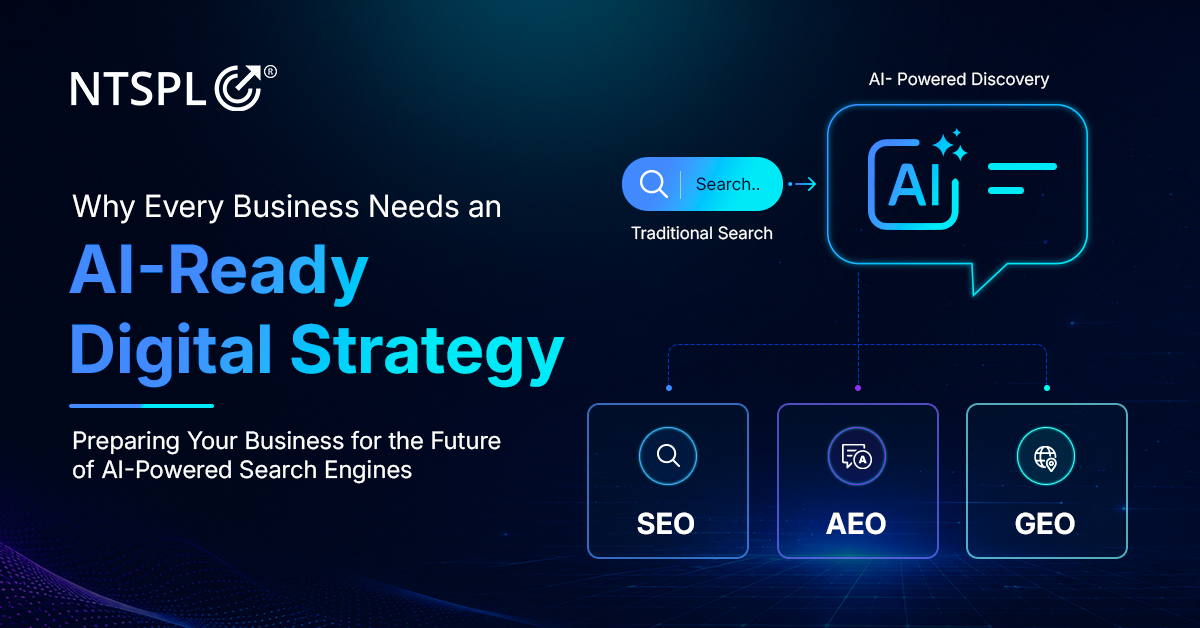
SEO, AEO and GEO for the New Era of Search and AI-Powered Discovery
An AI-ready digital strategy combines Search Engine Optimization (SEO), Answer Engine Optimization (AEO), and Generative Engine Optimization (GEO) to make a business discoverable, understandable and credible across search engines and AI-powered platforms. It aligns technical website performance, answer-led content, structured business information and brand authority so that both people and AI systems can find and trust the business. The way people search for products, services and business solutions is changing rapidly.
For years, organizations relied mainly on Search Engine Optimization to improve their Google rankings and attract website visitors. Today, decision-makers are no longer limited to entering short keywords into traditional search engines.
Users are now asking complete questions, comparing suppliers, evaluating software and requesting recommendations through platforms such as Google Search, Google AI Overviews, Google AI Mode, ChatGPT, Gemini, Microsoft Copilot, and Perplexity.
This shift means businesses must compete not only for rankings and website clicks but also for visibility inside direct answers, summaries, comparisons, citations and AI-generated recommendations.
At Nexus Technoware Solution Pvt. Ltd. (NTSPL), we help organizations strengthen their digital foundations through corporate website development, headless CMS, enterprise software solutions, AI-powered automation, cloud solutions, digital transformation and SEO, AEO and GEO services.
An AI-ready approach connects technology, content and digital authority so that a company can be found, understood, trusted and considered when customers search for relevant solutions.
What Is an AI-Ready Digital Strategy?
An AI-ready digital strategy is a coordinated plan for improving how a business appears across traditional search engines and AI-powered discovery platforms.
It brings together website technology, content quality, structured information, brand authority and performance measurement so that search engines can index the business and AI systems can accurately understand and reference it.
A complete strategy includes three connected pillars:
- SEO improves website crawlability, indexing, rankings and organic search traffic.
- AEO structures content around direct and accurate answers to conversational questions.
- GEO strengthens the authority, clarity and evidence that generative AI platforms may use when selecting sources or recommending businesses.
These are not competing strategies.
SEO creates the discoverable foundation, AEO improves answer clarity and GEO strengthens the brand’s ability to become a trusted source across AI-generated search experiences.
Why Is Traditional SEO Alone No Longer Enough?
Traditional SEO remains essential because search engines and AI search systems still depend on searchable, crawlable, and high-quality website content. However, customer search behaviour has evolved.
Today, users ask detailed and conversational questions such as:
- Which ERP solution is suitable for a manufacturing company?
- Who provides enterprise website development and headless CMS services?
- How can a business optimize its website for ChatGPT and Google AI search?
- What is the difference between SEO, AEO, and GEO?
- Which company provides AI search optimization services in India?
- What is the best HRMS solution for a growing organization?
- Which technology company provides AI-powered automation services?
In many of these search journeys, users may receive a complete answer before they visit a website.
AI-powered platforms may summarize information, compare providers, recommend solutions and display selected sources directly within the answer.
The selected sources are generally those that:
- Explain the topic clearly.
- Demonstrate relevant experience.
- Provide useful and original information.
- Maintain consistent business details.
- Support important claims with evidence.
- Structure information so it is easy to understand.
A webpage may rank for a keyword but still be overlooked in an AI-generated response when its content is vague, generic, poorly structured, outdated, or difficult to verify. This is why businesses need an integrated SEO, AEO and GEO strategy.
The Three Pillars of an AI-Ready Digital Strategy
1) Search Engine Optimization: Build the Discoverable Foundation
Search Engine Optimization (SEO) helps search engines find, understand, index and rank a website.
SEO remains the foundation of an AI-ready digital strategy because content cannot be selected, cited, or recommended consistently when the underlying website is inaccessible, slow, duplicated, or poorly organized.
Core SEO priorities
- Conduct keyword and search-intent research.
- Map primary and supporting keywords to the correct webpages.
- Create focused service pages with one main search intent per page.
- Improve website crawling and indexing.
- Create and maintain XML sitemaps.
- Use canonical tags correctly.
- Improve internal linking between related pages.
- Optimize meta titles and meta descriptions.
- Create a clear heading hierarchy.
- Optimize image file names and alt text.
- Use descriptive internal-link anchor text.
- Improve mobile usability and responsiveness.
- Strengthen website security and HTTPS implementation.
- Improve page-loading performance and Core Web Vitals.
- Build relevant and trustworthy backlinks.
- Keep important website content accurate and updated.
- Strengthen local and organizational information where relevant.
2) Answer Engine Optimization: Make Important Answers Easy to Find
Answer Engine Optimization (AEO) is the practice of organizing content so that users, search engines, voice assistants and AI-powered answer systems can quickly identify a clear response to a specific question.
AEO does not mean that every answer must be extremely short.
The most effective approach is to provide a concise answer first and then expand it with:
- Context
- Examples
- Comparisons
- Steps
- Use cases
- Limitations
- Supporting information
Important AEO practices: Use question-based headings : Headings should reflect the language used by real customers.
Examples include:
- What is an AI-ready digital strategy?
- What is the difference between SEO, AEO, and GEO?
- Does GEO replace SEO?
- How can a website be optimized for ChatGPT?
- How does NTSPL support AI search optimization?
- Is structured data required for AI search visibility?
Provide the answer before the explanation
Important sections should begin with a direct answer before presenting detailed information.
This makes the content easier for:
- Website visitors
- Search engines
- Voice assistants
- AI summaries
- Chat-based search platforms
Use clear content structures
AEO-friendly content commonly includes:
- Short definitions
- Numbered steps
- Comparison tables
- Process explanations
- How-to sections
- Frequently asked questions
- Concise summaries
- Clearly labelled benefits
- Problem-and-solution sections
Address conversational search intent
Businesses should not focus only on short keywords.
They should also answer detailed questions such as:
- How can AI search optimization help a B2B company?
- Which website structure is suitable for AI-powered search?
- How should a manufacturing company prepare for GEO?
- What information should be included on an enterprise software service page?
- How can a business increase its visibility in AI-generated answers?
AEO helps a business become useful at the exact moment when a potential customer is looking for an answer.
3) Generative Engine Optimization: Build Citation-Ready Brand Authority
Generative Engine Optimization (GEO) improves the quality and consistency of the information that generative AI platforms may use when selecting sources, summarizing information, comparing businesses, or recommending service providers.
The objective of GEO is not to manipulate an AI system.
Its purpose is to publish content that is:
- Accurate
- Helpful
- Distinctive
- Easy to verify
- Properly structured
- Clearly connected to a recognized company or brand
Effective GEO practices: Publish original and useful information, Businesses should avoid publishing only generic summaries that repeat information already available across hundreds of websites.
More valuable content includes:
- Original research
- Industry observations
- Customer case studies
- Implementation experiences
- Practical frameworks
- Expert commentary
- Whitepapers
- Process explanations
- Product comparisons
- Industry-specific use cases
Maintain clear brand information
A business should consistently use the same:
- Company name
- Service descriptions
- Contact details
- Website address
- Location information
- Social media profiles
- Product names
- Leadership information
For NTSPL, the full company name should be clearly associated with its core capabilities:
- Enterprise Software Solutions
- Corporate Website Development
- Headless CMS Development
- Odoo ERP Implementation
- HRMS Solutions
- AI-Powered Automation
- Cloud Solutions
- Digital Transformation
- Custom Application Development
- SEO, AEO and GEO Services
This consistency helps search engines and AI systems understand the relationship between the company, its services, and its areas of expertise. Demonstrate experience and expertise.
Important articles should include:
- Author name
- Author designation
- Short professional biography
- Reviewer details where required
- Original publication date
- Last updated date
- Relevant business experience
- Supporting case studies or examples
Support claims with evidence
Claims should be supported with:
- Real examples
- Approved customer outcomes
- Reliable references
- Process details
- Screenshots
- Original diagrams
- Data sources
- Case studies
Businesses should avoid unsupported claims such as “best company,” “number one provider,” or “guaranteed ranking” unless they have verifiable evidence. Create citation-ready content.
AI systems and readers can understand content more easily when it uses:
- Direct definitions
- Clear headings
- Self-contained paragraphs
- Comparison tables
- Numbered processes
- Concise answers
- Relevant examples
- Transparent limitations
Each important paragraph should make sense even when it is read separately from the complete article.
Business Benefits of Combining SEO, AEO, and GEO
Organizations that implement SEO, AEO and GEO as one connected strategy can achieve several long-term benefits.
Broader digital visibility
A business can appear across traditional search results, direct answers, AI summaries, recommendation journeys and conversational searches.
Better alignment with customer intent
Question-based and answer-led content addresses what customers actually need during the awareness, comparison, evaluation and purchase stages.
Stronger brand credibility
Expert-led and evidence-supported content helps establish the company as a reliable source of information.
More qualified website visitors
Users who discover a business through detailed answers and relevant comparisons are more likely to arrive with a clear understanding of the company’s capabilities.
Reduced dependence on one channel
A combined strategy reduces dependence on only Google rankings, paid advertisements, or social media promotion.
Better conversion opportunities
Well-structured content guides users from their initial question to the relevant service, solution, case study, enquiry form, or consultation.
Reusable business knowledge
A strong content knowledge base can support:
- Marketing
- Sales
- Customer service
- Business development
- Employee training
- Product documentation
Greater readiness for future search changes
Search interfaces will continue to evolve. A technically strong, authoritative and answer-focused digital presence gives businesses greater long-term resilience.
Essential Components of an AI-Ready Website
A future-ready business website should include the following elements:
- Fast and secure website performance
- Mobile-first responsive design
- HTTPS implementation
- Clear website navigation
- Logical information architecture
- Search-friendly HTML
- Crawlable internal links
- Canonical URLs
- Updated XML sitemaps
- Focused service pages
- Industry-specific solution pages
- Detailed use cases
- Customer-focused FAQs
- Customer testimonials
- Genuine case studies
- Expert author profiles
- Thought leadership articles
- Original visuals and diagrams
- Relevant structured data
- Consistent business information
- Regular content updates
- Analytics and conversion tracking
Relevant structured data may include:
- Organization
- WebSite
- WebPage
- Article
- BlogPosting
- BreadcrumbList
- Service
- Product
- Person
Structured data should always match the information that is visibly available on the webpage.
The NTSPL AI-Ready Visibility Framework
NTSPL can help organizations implement an AI-ready strategy through five connected stages.
Stage 1: Discover
The first stage is to understand the organization’s existing digital position.
This includes reviewing:
- Website technical performance
- Indexed and non-indexed webpages
- Current keyword visibility
- Existing service content
- Competitor content
- Brand mentions
- Backlink profile
- Customer search behaviour
- Frequently asked customer questions
- AI-generated results for important business queries
The audit should identify questions customers ask during:
- Awareness
- Research
- Comparison
- Evaluation
- Purchase
Stage 2: Structure
The next stage is to create a clear website and content structure. Each important webpage should have one main purpose and search intent. Related content should be connected through internal links.
Pages should use:
- Clear headings
- Direct answers
- Definitions
- Comparison tables
- Numbered steps
- FAQs
- Industry examples
- Contextual calls to action
A properly structured website helps both users and AI systems understand the relationship between the company’s services, solutions, industries and expertise.
Stage 3: Prove
The third stage is to add evidence that generic content cannot provide.
This may include:
- NTSPL’s implementation experience
- Expert observations
- Customer case studies
- Product capabilities
- Process details
- Original research
- Approved customer outcomes
- Screenshots
- Diagrams
- Demonstrations
- Author and reviewer information
The objective is to show why the business is qualified to discuss the topic and deliver the service.
Stage 4: Distribute
Useful content should not remain limited to one corporate blog.
It can be repurposed and distributed across:
- Corporate websites
- YouTube
- Industry portals
- Partner platforms
- Business directories
- Relevant professional communities
- Product documentation
- Presentation materials
- Email newsletters
Distribution should build genuine brand recognition and authority rather than artificial mentions.
Stage 5: Measure and Improve
An AI-ready digital strategy requires continuous measurement.
Businesses should monitor:
- Organic impressions
- Keyword rankings
- Website clicks
- Organic traffic
- Enquiries and conversions
- Branded searches
- AI-platform referral traffic
- Brand mentions
- Cited pages
- Conversion quality
- Frequently discovered webpages
- Content update requirements
Content should be reviewed whenever services, examples, products, customer questions, or industry information change.
A Practical Roadmap to Become AI-Ready
Step 1: Audit the existing digital presence
Conduct a technical SEO, content, business-entity and AI-crawlability audit.
Step 2: Understand customer questions
Create a search-intent and customer-question map for every important service and industry.
Step 3: Improve priority service pages
Strengthen high-value service pages before publishing large volumes of new blog content.
Step 4: Introduce answer-first content
Rewrite important pages using direct answers, question-based headings, comparison tables, practical examples and FAQs.
Step 5: Publish expert-led resources
Develop:
- Case studies
- Whitepapers
- Implementation guides
- Research-based blogs
- Comparison pages
- Industry-specific solution guides
- Thought leadership articles
Step 6: Implement technical improvements
Improve structured data, internal linking, website speed, crawlability, indexing, mobile usability and information architecture.
Step 7: Build authentic authority
Strengthen authority through:
- Industry partnerships
- Expert contributions
- Digital PR
- Quality backlinks
- Client mentions
- Business directories
- Professional communities
Step 8: Measure and continuously improve
Track traditional search performance and emerging AI visibility, and then update the strategy based on measurable results.
Which Industries Can Benefit from an AI-Ready Strategy?
Any organization that depends on digital discovery, customer trust, online comparisons, or business enquiries can benefit.
An AI-ready digital strategy is particularly valuable for:
- Manufacturing
- Mining
- Engineering
- Industrial services
- Healthcare
- Education
- Government organizations
- Public-sector organizations
- Banking
- Financial services
- Insurance
- Information technology
- Software companies
- Cloud-service providers
- Cybersecurity companies
- Retail
- eCommerce
- Logistics
- Professional services
- Multi-location businesses
For complex B2B industries, AEO and GEO are particularly valuable because buyers often ask detailed questions before contacting a provider.
A company that clearly explains its solutions, implementation process, integrations, compliance considerations, industry experience and use cases is more likely to build confidence during the customer’s research journey.
How NTSPL Helps Businesses Build an AI-Ready Digital Presence
Nexus Technoware Solution Pvt. Ltd. (NTSPL) supports organizations through an integrated combination of technology, content, search optimization and digital strategy.
SEO and technical website audits,
NTSPL can evaluate and improve:
- Website crawling
- Search indexing
- Technical performance
- Website speed
- Mobile usability
- Information architecture
- Metadata
- Internal linking
- Service-page structure
AEO-focused content planning
NTSPL can identify important customer questions and transform them into clear, useful, and answer-led website content.
This may include:
- FAQ sections
- How-to guides
- Comparison pages
- Problem-and-solution pages
- Service explanations
- Industry-specific questions
- Implementation guides
GEO content strategy
NTSPL can strengthen:
- Expert knowledge
- Brand authority
- Entity consistency
- Citation-ready content
- Case studies
- First-party insights
- Thought leadership
- External business mentions
- AI search visibility
Corporate website and headless CMS development
NTSPL develops scalable websites and content-management solutions that support faster publishing, structured content, improved performance and future digital growth.
Enterprise service-page optimization
NTSPL can optimize pages related to:
- Enterprise software
- Odoo ERP
- HRMS
- AI-powered automation
- Cloud solutions
- Digital transformation
- Corporate website development
- Headless CMS
- Custom application development
Analytics and continuous optimization
NTSPL can help measure:
- Organic traffic
- Rankings
- Search impressions
- Leads
- Conversion rates
- Branded visibility
- AI-platform referrals
- Important landing-page performance
The objective is not to optimize a business for only one search platform. NTSPL helps organizations create a connected digital presence that can perform across traditional search engines, AI-assisted discovery platforms, social media and the wider customer journey.
Common SEO, AEO and GEO Mistakes to Avoid
Businesses should avoid the following mistakes:
- Publishing large volumes of generic AI-generated content without expert review.
- Treating SEO, AEO and GEO as completely separate campaigns.
- Using inconsistent messages across service pages and profiles.
- Stuffing keywords instead of answering the user’s real question.
- Hiding the main answer below a long introduction.
- Publishing vague service descriptions.
- Making unsupported “best,” “number one,” or guaranteed-ranking claims.
- Using inconsistent company names and contact information.
- Ignoring website crawlability and indexing.
- Blocking important search crawlers unintentionally.
- Ignoring JavaScript-rendering issues.
- Neglecting mobile performance and website speed.
- Publishing outdated statistics or service information.
- Failing to add author and update information.
- Measuring only keyword rankings.
- Ignoring conversions, brand searches, AI referrals, and cited pages.
- Publishing FAQs that do not genuinely help users.
- Failing to provide case studies, evidence, or original insights.
Avoiding these mistakes helps businesses build sustainable search visibility and long-term digital authority.
FAQ:
1) What is the difference between SEO, AEO and GEO?
SEO improves visibility within traditional search engine results. AEO structures content so that it directly answers specific user questions. GEO strengthens the authority, evidence and brand signals that may help AI platforms understand, cite, or recommend a business. The strongest approach combines all three.
2) Does GEO replace traditional SEO?
No. Generative Engine Optimization does not replace SEO. Website crawlability, indexing, content quality, technical performance, and authority remain the foundation. GEO extends that foundation by making information more distinctive, structured, verifiable, and useful within AI-generated answers.
3) How can a website be optimized for ChatGPT and other AI platforms?
A business should publish accurate, public, crawlable and well-structured content. It should clearly explain its services, provide consistent company information, demonstrate expertise, use supporting evidence, maintain updated pages and allow relevant search crawlers according to its publishing policy. However, no platform guarantees citation or top placement.
4) Is structured data required for AI search visibility?
Structured data can help search engines understand the type and context of webpage content, but it does not guarantee rankings or AI citations. Businesses should use relevant schema, such as Organization, Article, BlogPosting, Service and Breadcrumb and ensure that it matches the visible webpage content.
5) Why is an FAQ section important for AEO?
Users may not frequently search for the term “AEO,” but they constantly ask questions. A useful FAQ section captures conversational search intent, resolves customer concerns, supports voice and AI-assisted discovery, and helps visitors evaluate whether the company is relevant to their requirements.
6) How long does an AI-ready digital strategy take to show results?
There is no fixed timeline. Results depend on the website’s existing technical condition, competition, content quality, authority, crawl frequency and the number of improvements required. Technical changes may be detected earlier, while stronger brand authority and consistent AI visibility generally require continuous effort.
7) Can manufacturing and B2B companies benefit from SEO, AEO and GEO?
Yes. B2B buyers frequently research complex questions before contacting a vendor. Detailed service pages, industry-specific use cases, integration information, implementation guidance, compliance explanations and case studies can improve both search visibility and buyer confidence.
8) How does NTSPL support SEO, AEO and GEO implementation?
NTSPL combines technical website improvement, corporate website and headless CMS development, search-intent research, answer-led content, business-entity optimization, expert resources, analytics and continuous digital strategy into one AI-ready digital roadmap.
Be Discoverable, Understandable, Trusted and Recommendable
The future of digital visibility is not only about appearing on the first page of a search engine.
It is about becoming a source that search engines can index, customers can understand and AI systems can confidently reference when responding to a relevant question.
Businesses that combine SEO, AEO and GEO within one AI-ready digital strategy can build stronger organic visibility, clearer customer journeys, greater brand authority and more sustainable lead-generation opportunities.
Organizations that prepare today will be better positioned as search becomes increasingly conversational, contextual and AI-assisted.
Nexus Technoware Solution Pvt. Ltd. (NTSPL) helps businesses modernize their websites, content, enterprise systems and digital presence for the next generation of search and business discovery.
The right starting point is a practical digital audit followed by a prioritized roadmap covering technical SEO, answer-ready content, brand authority and measurable AI visibility.
Ready to Build an AI-Ready Digital Presence?
Make your business more discoverable across search engines and AI-powered platforms.
Explore SEO, AEO, GEO, corporate website development, headless CMS, enterprise software, AI automation, and digital transformation services from NTSPL.
Book a Free Consultation: +91 8260003333
Email: info@ntspl.co.in
Website: www.ntspl.co.in
Explore Our Digital Marketing Services: https://www.ntspl.co.in/services/digital-marketing/
About NTSPL
Nexus Technoware Solution Pvt. Ltd. (NTSPL) is a technology consulting and software development company specializing in enterprise software solutions, corporate website development, headless CMS, Odoo ERP implementation, HRMS, AI-powered automation, cloud solutions, digital transformation, custom application development and AI search optimization.
NTSPL helps organizations improve operational efficiency, digital visibility, customer engagement and sustainable business growth.