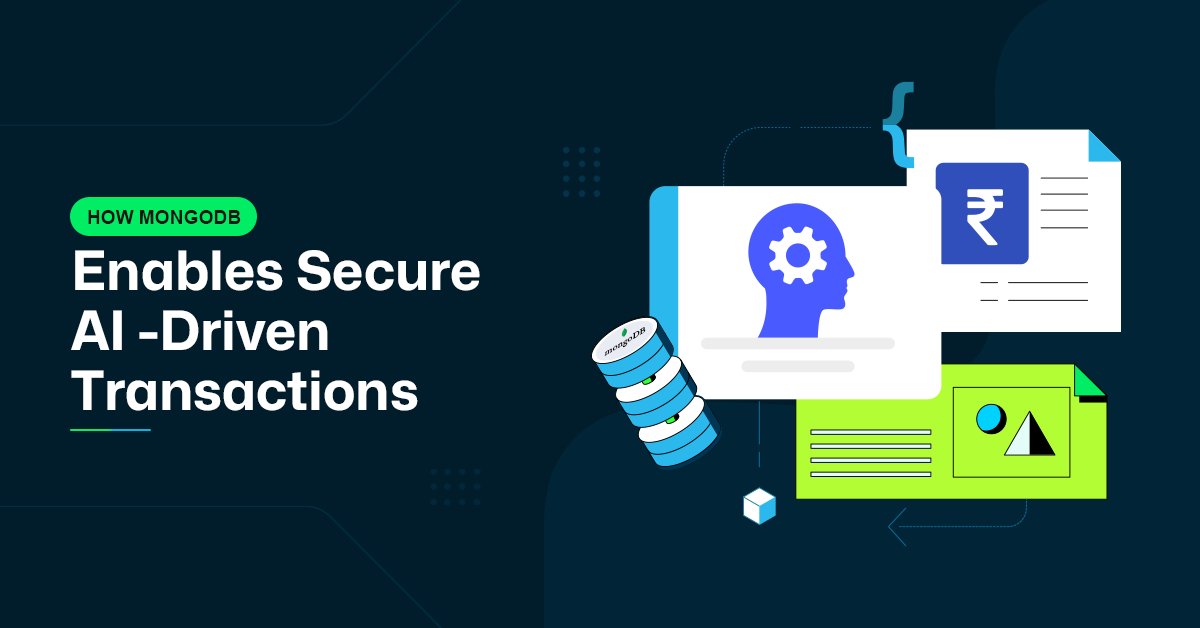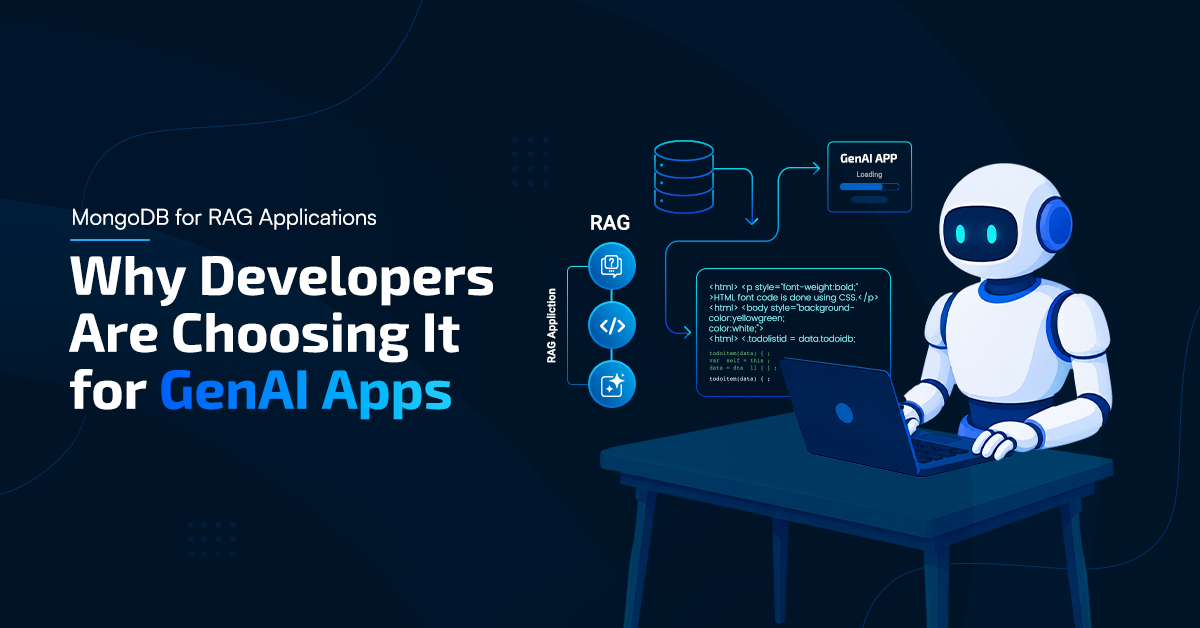
As GenAI applications move from experiments to production systems, developers are under pressure to build applications that deliver more accurate, relevant, and trustworthy responses. Large language models are powerful, but on their own, they can produce outdated, generic, or ungrounded answers. That is why Retrieval-Augmented Generation or RAG has become one of the most important patterns in modern AI development. MongoDB’s own documentation describes RAG as a workflow where you ingest data, retrieve relevant documents with Vector Search, and then generate responses using an LLM.
This shift is also why many teams are now evaluating MongoDB for RAG applications rather than using separate tools for operational data, document storage, and vector retrieval. MongoDB positions Vector Search as a way to store and query vector data alongside the rest of your application data, while also supporting semantic search, hybrid search and filtering on other fields in the same collection.
In this guide from NTSPL, we explain what RAG means, why MongoDB is becoming a preferred choice for GenAI apps, what features matter most in 2026, and how developers should evaluate MongoDB when building AI-powered systems.
RAG stands for Retrieval-Augmented Generation. It is an AI design pattern in which an application retrieves relevant information from a knowledge source before sending that context to a language model for response generation. MongoDB describes this as a method for combining language models with your own data so applications can provide more accurate, domain-specific answers grounded in custom information.
A common misunderstanding is that an LLM alone is enough for enterprise AI. In reality, most production use cases need access to internal documents, product data, policies, support content, or structured business information. Without retrieval, responses can easily become vague or disconnected from the actual source material. That is why RAG has become a practical foundation for chatbots, knowledge assistants, semantic search systems, and AI copilots.
Why MongoDB for RAG Applications Matters.
Businesses building GenAI apps need more than just a vector database. They also need operational storage, filtering, metadata support, scalability, and a development model that fits real applications. MongoDB’s value here is that it combines vector search with document data, filtering, and broader application data workflows in one platform. MongoDB states that Vector Search allows teams to query data based on semantic meaning, combine vector search with full-text search, and filter across other fields in the same collection.
This matters because real RAG systems rarely work on embeddings alone. Developers usually need to store source text, metadata, access rules, document categories, timestamps, user-specific filters, and application state together. A fragmented stack can make these workflows harder to build and maintain. MongoDB reduces that complexity by allowing developers to work with vectors and operational data in one environment.
In 2026, this becomes even more important because GenAI apps are expected to be fast, secure, personalized, and connected to live business data. The result is simple: basic LLM integration may be enough for demos, but production AI systems need a stronger retrieval and data foundation.
MongoDB in 2026: What’s Current?
As of now, MongoDB’s current stable release line is the 8.2 series, and MongoDB describes 8.2 as the current stable release in its official release notes. MongoDB also notes that Vector Search continues to be part of its broader AI-ready platform direction, alongside other built-in query capabilities.
That makes it important for any new technical buying guide or architectural blog in 2026 to discuss MongoDB not just as a document database, but as a platform increasingly positioned for AI-ready application development, including RAG, semantic search, and agentic workflows. MongoDB’s current docs and learning materials explicitly promote RAG, local RAG, and AI-agent-oriented vector search use cases.
What Features Should You Look for in MongoDB for RAG Applications?
1) Vector Search Built Alongside Operational Data: One of the main reasons developers choose MongoDB is that vector data can live alongside application data in the same platform. MongoDB says Vector Search lets you search indexed vector data stored in Atlas together with the rest of your collection data.
That is important because most RAG applications need far more than embeddings. They need source content, structured metadata, application state, permissions, and supporting business records.
2) Semantic Search with Filtering:
RAG quality depends heavily on retrieval quality. MongoDB supports semantic search and also allows developers to pre-filter data and query on additional fields. This helps teams narrow results by category, tenant, document type, timestamp, or other business rules.
In practical terms, that means a GenAI application can retrieve not just “similar” content, but the right content within the proper business context.
3) Hybrid Search Possibilities:
Many real-world AI applications benefit from combining semantic search with lexical or full-text search. MongoDB explicitly highlights that Vector Search can be combined with full-text search for more relevant results.
This matters because some user queries depend on intent and meaning, while others depend on exact phrases, product names, codes, or technical terms. Hybrid approaches often perform better than relying on one retrieval method alone.
4) Support for RAG and AI Agent Workflows:
MongoDB’s current documentation directly covers RAG tutorials, local RAG implementations, and AI agent workflows powered by vector search. MongoDB presents these as practical application patterns rather than niche experiments.
That makes MongoDB attractive for teams who want to move beyond simple chat experiences and build assistants that can retrieve context, remember relevant information, and act on business data.
5) Scalability for Production GenAI Apps: Developers building GenAI apps need a database platform that scales beyond prototypes. MongoDB continues to position Atlas as an AI-ready database platform with built-in support for RAG-related workflows and scalable application development.
A RAG application may start with a few thousand documents, but production systems often grow into much larger knowledge bases with more users, more retrieval requests, and stricter latency expectations.
6) Developer-Friendly Ecosystem:
MongoDB provides official documentation and tutorials for RAG implementations, local RAG patterns, and driver-based vector search usage. That lowers the barrier for developers who want to build quickly without stitching together too many unrelated tools.
Ease of adoption matters. When a platform has strong learning resources and direct examples, teams can move faster from proof of concept to usable product.
7) Single Platform Simplicity:
One of the biggest operational advantages of MongoDB for RAG is architectural simplicity. Instead of maintaining one system for operational data, another for document storage, and another for vector retrieval, teams can often consolidate more of the workflow in one place. This is an inference based on MongoDB’s official positioning around storing vector data alongside operational data and using the same platform for AI-powered apps.
That kind of simplification can reduce data movement, integration overhead, and maintenance burden.
MongoDB for RAG vs Traditional Database Setups
Traditional database environments are often not designed around semantic retrieval. They may work well for exact lookups, structured records, and transactional workloads, but RAG requires embedding-based similarity search, contextual filtering, and relevance-oriented retrieval.
MongoDB for RAG is different because it combines document flexibility with vector search and application-aware metadata in one environment. MongoDB’s official docs emphasize that vector search is used for semantic search, hybrid search, and generative search use cases, including RAG.
In other words, a traditional database may store your content, but MongoDB is increasingly designed to help you retrieve that content in a way that fits modern AI applications.
How to Choose the Right MongoDB Approach for RAG Applications
When evaluating MongoDB for a GenAI project, do not focus only on storage. Ask practical questions:
1) Will the application need semantic search, hybrid search, or both?
2) What metadata filters will be required for retrieval quality?
3) How will documents be chunked, embedded, and indexed?
4) Will the application need tenant isolation or permission-aware retrieval?
5) How will relevance be measured and improved over time?
6) Will the workload remain experimental, or does it need production scalability?
MongoDB provides the retrieval and data-layer capabilities, but the quality of the final RAG application still depends on good data preparation, strong chunking strategy, proper indexing, and evaluation discipline. MongoDB’s own learning materials also stress that high-quality responses depend on high-quality data.
Important Note for Businesses
Using MongoDB for RAG does not automatically make a GenAI application accurate, secure, or production-ready. Retrieval quality, prompt design, source data quality, permissions, monitoring, and evaluation all still matter. MongoDB can provide a strong base for semantic retrieval and AI-ready data handling, but the final success of the application depends on how the full system is designed. This is consistent with MongoDB’s documentation, which presents RAG as a pipeline involving several coordinated steps rather than a one-click feature.
That is why businesses should treat MongoDB as a strategic retrieval and data layer, not as the whole GenAI solution by itself.
In 2026, choosing MongoDB for RAG applications is less about following a trend and more about building AI systems on a practical data foundation. Developers are choosing MongoDB because it supports semantic retrieval, filtering, hybrid search, and application data in a way that aligns with real-world GenAI needs. MongoDB’s official platform and documentation increasingly position it as an AI-ready database for use cases such as RAG, vector search, and agent workflows.
For businesses planning to launch or scale a GenAI application, the smart approach is to evaluate retrieval quality, operational simplicity, scalability, and data integration together. Accuracy, relevance, and system design should all be part of the decision.
At NTSPL, we recommend treating RAG as a long-term application architecture strategy, not a one-time AI feature. MongoDB can play a strong role in that strategy, especially when retrieval, business data, and production-readiness need to work together.
FAQ:
1) What is MongoDB for RAG?
MongoDB for RAG refers to using MongoDB’s data platform, especially Vector Search, to store, index, and retrieve relevant context for Retrieval-Augmented Generation applications. MongoDB officially documents RAG as a workflow using data ingestion, retrieval with Vector Search, and generation with an LLM.
2) What is MongoDB for RAG?
Developers are choosing MongoDB because it supports vector search alongside operational data, semantic retrieval, hybrid search, and metadata-based filtering in one platform.
3) What is MongoDB for RAG?
MongoDB states that you can use MongoDB as a vector database through MongoDB Vector Search, which lets you search vector data alongside other collection data.
4) What is MongoDB for RAG?
Yes. MongoDB’s current docs and learning resources include guidance for AI-agent workflows and local RAG implementations.
5) What is MongoDB for RAG?
MongoDB’s official release notes list the 8.2 series as the current stable release line.