The way businesses process documents is rapidly changing. Organizations that traditionally depend on employees to manually read, verify and enter information from purchase orders, invoices, medical reports, employee forms and other business documents can now automate a significant part of these processes through AI-Powered Document Intelligence.
As part of the NTSPL TechSphere knowledge-sharing initiative, the .NET Team at Nexus Technoware Solution Pvt. Ltd. recently conducted an insightful technical session on:
“AI-Powered OCR & Intelligent Document Processing – Building an Enterprise Document Intelligence Platform Using .NET Core & Angular.”
The session explored how AI-Powered OCR, Intelligent Document Processing (IDP) and Enterprise Document Intelligence can transform traditional document workflows into intelligent, scalable and reusable business processes.
The Challenge with Manual Document Processing
Many enterprise processes still depend heavily on documents. Purchase orders, invoices, contracts, employee documents, medical reports and compliance forms often require employees to manually review information and enter it into business applications.
This can lead to data-entry errors, longer processing times, repetitive administrative effort, increased operational costs and difficulty scaling as document volumes increase. This is where AI Document Processing and Automated Document Processing can create opportunities for organizations to improve document-driven workflows.
What Is AI-Powered Document Intelligence?
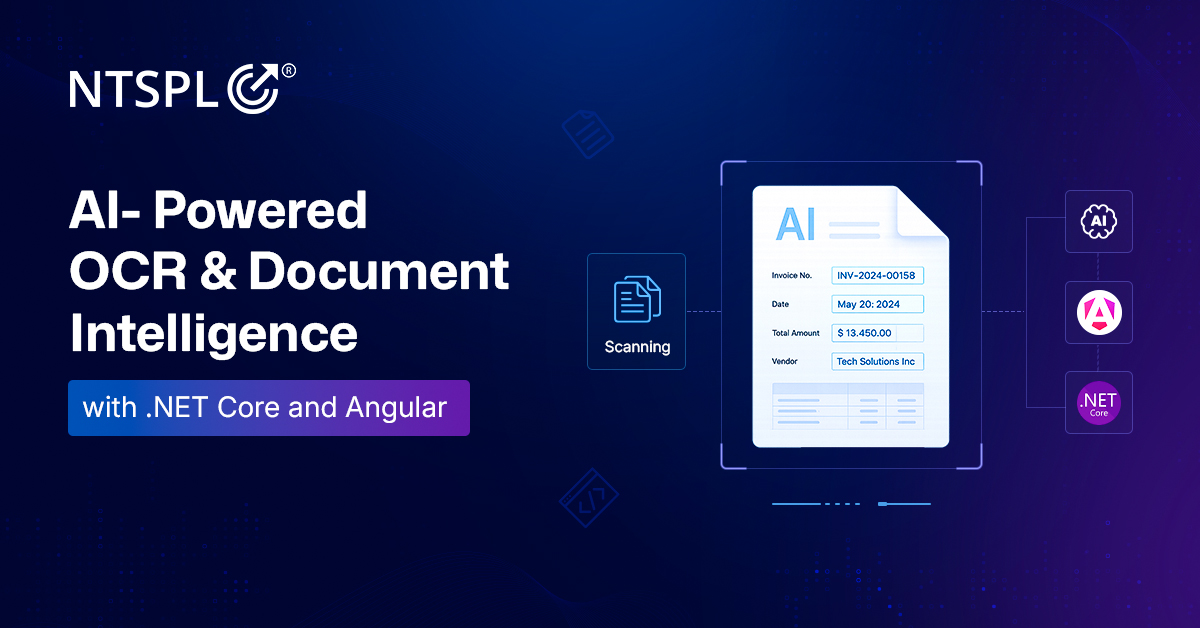
AI-Powered Document Intelligence is an approach that combines OCR with Artificial Intelligence to classify documents, identify important information, perform Intelligent Data Extraction, validate extracted data and convert information into structured formats that enterprise applications can use.
Unlike conventional OCR, AI Document Intelligence focuses not only on reading text but also on understanding and processing the information contained within business documents.
Traditional OCR vs. AI Document Intelligence
One of the key topics discussed during the NTSPL TechSphere session was:
What is the difference between OCR and AI Document Intelligence?
Traditional Optical Character Recognition (OCR) primarily converts text contained in scanned documents or images into machine-readable text. However, extracting text is only the beginning. Businesses still need to classify the document, identify relevant information, validate extracted data and map that information into enterprise applications.
Intelligent Document Processing extends this process through:
Document Classification → AI-Powered OCR → AI Extraction → Validation → JSON Mapping → Enterprise Application Integration
This allows organizations to build more complete Document Automation workflows rather than simply digitizing text.
How Does AI Document Intelligence Work?
A typical Enterprise Document Intelligence architecture can follow this workflow:
Upload → Document Storage → Classification → OCR Engine → AI Extraction → Validation → JSON Mapping → Application → Database → Audit
When a document enters the system, the platform can first identify its type and then route it to the appropriate processing model.
Examples include:
- Purchase Orders
- Invoices
- Medical Reports
- Passports
- Employee Forms
- Contracts
This enables more scalable AI-powered document workflow automation.
Intelligent Data Extraction from Business Documents
Consider a purchase order.
Instead of an employee manually reading and entering every value, AI Document Extraction can identify information such as:
- PO Number
- Vendor
- Date
- Amount
- GST
- Line Items
- Checkbox Values
- Signature Presence
The extracted information can then be converted into structured JSON and supplied to the enterprise application. This demonstrates how AI-based document data extraction can reduce repetitive manual data-entry activities.
Confidence Scores and Human-in-the-Loop Validation
Reliable Intelligent Document Processing requires more than extraction. Each extracted value can receive a confidence score representing how certain the AI system is about the information.
A workflow discussed during the session included:
Above 95% Confidence – Auto-Approve
70%–95% Confidence – Human Review
Below 70% Confidence – Manual Entry
This approach is known as Human-in-the-Loop Document Processing or Human-in-the-Loop Validation. It combines automation with human verification so uncertain information can still be reviewed before entering critical business processes.
AI Document Intelligence with .NET Core and Angular
Another important topic explored during the session was AI Document Intelligence with .NET Core and Angular. Once document information is extracted, it can be converted into structured JSON and passed through:
JSON → Mapping Layer → Validation Layer → .NET Core APIs → SQL Server
The Angular application can then use the structured information to automatically populate relevant fields. For example, after uploading a purchase order, information such as the PO number, vendor, date and amount can automatically appear inside an Angular form for review and approval. This provides a practical approach to AI Integration with .NET Core and modern enterprise applications.
Why Is JSON Important in Document Intelligence?
JSON provides a structured integration layer between AI Document Processing and business applications. Instead of passing unstructured OCR text into an application, extracted data can be standardized into structured JSON.
This allows APIs, applications and databases to process document information more effectively.
This is why one of the important takeaways from the NTSPL TechSphere session was:
“JSON is the integration layer.”
Choosing the Right OCR and Document Intelligence Technology
Several technologies can support Enterprise Intelligent Document Processing Solutions, including:
- Azure AI Document Intelligence
- Google Document AI
- AWS Textract
- PaddleOCR
- Tesseract
Commercial platforms may provide managed models and enterprise support, while open-source technologies may provide greater control over infrastructure and hosting. The right technology therefore depends on accuracy requirements, document types, cost, hosting strategy and enterprise requirements.
Building a Reusable Document Intelligence Service
One of the strongest architectural concepts explored during the session was establishing a reusable Document Intelligence Service. Instead of developing a separate AI OCR Solution for every application, a common service can handle:
- Document Classification
- OCR
- AI Extraction
- Validation
- Structured JSON Output
- Provider Integration
Multiple enterprise applications can then consume these capabilities. This creates a Reusable Document Intelligence Service rather than several separate OCR implementations.
Avoiding Vendor Lock-In with Provider Abstraction
A provider-independent architecture can separate the enterprise application from the underlying OCR technology.
For example:
Angular → API Gateway → Document Intelligence Service → Provider Abstraction Layer
The Provider Abstraction Layer can connect with technologies such as:
Azure AI | Google AI | AWS | PaddleOCR | Tesseract
This allows the application to communicate with one common service rather than depending directly on a specific OCR technology. Such an OCR Provider Abstraction Architecture can provide greater flexibility if technology requirements, costs or providers change in the future.
Enterprise Document Intelligence Across NTSPL Solutions
A reusable NTSPL Document Intelligence Service could potentially support multiple NTSPL solutions and business domains.
Potential areas discussed during the TechSphere session included:
- OHMS
- HRMS
- Vendor Management
- Procurement
- Finance
- ERP Applications
- Future NTSPL Products
For example, AI Document Processing for Procurement could help process purchase orders and invoices, while an HRMS application could use the same service to support employee-document workflows.
Rather than developing an OCR engine separately for each product, the common service could provide reusable Enterprise Document Automation capabilities.
One Platform. Many Products. Fully Reusable.
Security and Governance for Enterprise Document Intelligence An Enterprise Document Intelligence Platform may process confidential and sensitive documents, making security and governance essential.
Important considerations discussed during the session included:
- Encryption
- Role-Based Access
- Audit Trails
- Document Versioning
- Data Residency
- Sensitive Document Protection
- Compliance Requirements
Security should therefore be integrated into the architecture from the beginning rather than treated as an additional feature later.
Commercial OCR APIs vs. Open-Source OCR
Businesses evaluating an Enterprise OCR Solution also need to consider the total cost of ownership. Commercial services generally provide managed infrastructure and require less internal maintenance but typically follow usage-based pricing. Open-source OCR can reduce licensing costs but may require additional infrastructure, hosting, tuning and technical maintenance. A provider-independent architecture allows businesses to choose technologies according to individual document-processing requirements.
How Can Businesses Automate Document Processing?
Businesses can introduce AI-powered document automation by combining document classification, OCR, AI extraction, business-rule validation, structured JSON and application integration. Rather than attempting complete automation immediately, organizations can start with a limited document type and gradually expand the solution.
A phased approach discussed during the session included:
Phase 1 – Proof of Concept
Validate the document type and extraction technology.
Phase 2 – Pilot
Implement the solution for a real business use case.
Phase 3 – Production
Strengthen security, validation, performance and enterprise integration.
Phase 4 – Enterprise Rollout
Extend the Document Intelligence Platform across multiple applications.
Phase 5 – AI Optimization
Continuously improve extraction and processing using real-world experience and data.
Key Takeaways from the NTSPL TechSphere Session
1. AI Is More Than OCR
AI-Powered Document Intelligence goes beyond text recognition through classification, extraction, validation and application integration.
2. Validation Is Essential
Confidence-based validation and Human-in-the-Loop processing help create more reliable enterprise workflows.
3. JSON Is the Integration Layer
Structured JSON provides a bridge between AI Document Processing and enterprise applications.
4. A Reusable Platform Can Reduce Development Effort
A common Document Intelligence Service can support multiple enterprise solutions instead of implementing separate OCR capabilities repeatedly.
5. Provider Abstraction Can Reduce Vendor Dependency
A provider-independent architecture provides greater flexibility to evaluate different OCR technologies over time.
Building a Culture of Continuous Technology Learning at NTSPL
Through NTSPL TechSphere, our teams get an opportunity to explore emerging technologies, discuss practical implementation approaches and evaluate how those technologies can potentially contribute to NTSPL products and enterprise solutions.
A special appreciation to Mr. Rakesh and the .NET Team: Balaram, Santosh, Satyasundar, Ankit and Suryamani, for contributing their knowledge and making the session informative and engaging.
At Nexus Technoware Solution Pvt. Ltd., we remain committed to continuous learning, technical collaboration and innovation while exploring Enterprise AI Solutions, AI Automation Solutions and scalable digital technologies.
FAQs:
1. What is AI-Powered Document Intelligence?
AI-Powered Document Intelligence combines OCR and Artificial Intelligence to classify documents, extract relevant information, validate data and generate structured information that can be integrated with enterprise applications.
2. What is the difference between traditional OCR and AI Document Intelligence?
Traditional OCR mainly converts text in documents into machine-readable text. AI Document Intelligence extends this with document classification, Intelligent Data Extraction, confidence-based validation, JSON generation and application integration.
3. How is NTSPL exploring AI Document Intelligence with .NET Core and Angular?
At Nexus Technoware Solution Pvt. Ltd. (NTSPL), the .NET Team explored an AI Document Intelligence with .NET Core and Angular architecture where extracted information can be converted into JSON, validated through business rules and integrated with .NET Core APIs, SQL Server and Angular applications.
4. How can NTSPL use a reusable Document Intelligence platform across enterprise applications?
A common NTSPL Document Intelligence Service can potentially allow OHMS, HRMS, Vendor Management, Procurement, Finance and future NTSPL products to reuse common document classification, AI-Powered OCR, extraction and validation capabilities.
5. Why is provider-independent architecture important for Enterprise Document Intelligence?
A provider-independent Document Intelligence architecture separates business applications from individual OCR providers. This can provide greater flexibility to work with technologies such as Azure AI Document Intelligence, Google Document AI, AWS Textract, PaddleOCR or Tesseract depending on future business and technical requirements.
AI-Powered Document Intelligence represents a significant evolution from traditional OCR.
By combining Intelligent Document Processing, AI-Powered OCR, Document Automation, intelligent validation, structured JSON, .NET Core, Angular and provider-independent architecture, enterprises can build more scalable and reusable document-processing workflows.
For NTSPL, the larger opportunity explored during this TechSphere session is not simply implementing OCR for one application. It is evaluating how a reusable Enterprise Document Intelligence Service can potentially support multiple products and document-driven workflows.
Through NTSPL TechSphere, our teams continue to learn, share technical knowledge and explore practical applications of emerging technologies.
Learn. Share. Innovate. Build the Future Together.
Book a Free Consultation: +91 8260003333
Email: info@ntspl.co.in
Website: www.ntspl.co.in
#NTSPL #NTSPLTechSphere #DocumentIntelligence #IntelligentDocumentProcessing #AIpoweredOCR #DocumentAutomation #ArtificialIntelligence #DotNETCore #Angular #EnterpriseAI #KnowledgeSharing #ContinuousLearning #DigitalTransformation #Innovation