In today’s fast-evolving digital ecosystem, businesses need web applications that are secure, scalable, and future-ready. While many frameworks have come and gone, Laravel continues to dominate the PHP ecosystem in 2026.
From startups to enterprises, Laravel has become the go-to framework for building modern, high-performance applications without compromising development speed or code quality.
What is Laravel?
Laravel is an open-source PHP framework designed to make web development faster, cleaner, and more efficient. It follows the MVC (Model-View-Controller) architecture, helping developers organize code and build applications with ease.
What sets Laravel apart is its developer-friendly syntax, powerful built-in tools, and an ecosystem that simplifies complex tasks like authentication, routing, caching, and database management.
Why Use Laravel in 2026?
Laravel isn’t just popular, it’s practical. Here’s why it continues to lead:
- Rapid Development
Laravel offers pre-built modules and tools, reducing development time significantly. Features like Artisan CLI and ready-to-use packages accelerate project delivery.
- Clean & Scalable Architecture
Its MVC structure ensures clean code, making applications easy to scale and maintain, even for large enterprise systems.
- Built-in Security Features
Laravel provides strong security mechanisms such as:
- CSRF protection
- SQL injection prevention
- Authentication & authorization systems
- Robust Ecosystem
Laravel comes with powerful tools like:
- Laravel Forge (server management)
- Laravel Vapor (serverless deployment)
- Laravel Nova (admin panels)
- Database Management Made Easy
With Eloquent ORM, Laravel simplifies database interactions, reducing the complexity of writing raw SQL queries.
Why Laravel is Important for Modern Businesses
In 2026, businesses are no longer just building websites, they are creating digital ecosystems.
Laravel helps organizations:
- Build secure enterprise-grade applications
- Develop custom business solutions (CRM, ERP, CMS)
- Launch products faster with reduced cost
- Ensure long-term scalability and performance
Simply put, Laravel bridges the gap between speed and quality.
Who Can Use Laravel?
Laravel is flexible enough to serve multiple user groups:
Startups
Quick MVP development with minimal resources.
Enterprises
Scalable architecture for complex systems and integrations.
Developers
Clean syntax and extensive documentation make it beginner-friendly yet powerful.
Agencies & IT Companies
Perfect for delivering client projects efficiently and maintaining high code standards.
Key Features of Laravel
Laravel’s strength lies in its features. Here are the most important ones:
- Artisan CLI
Automates repetitive tasks like migrations, testing, and routing.
- Eloquent ORM
Simplifies database operations with an elegant syntax.
- Blade Templating Engine
Lightweight and powerful templating system for dynamic UI rendering.
- Built-in Authentication
Ready-to-use authentication and authorization systems.
- Routing System
Clean and flexible routing for better URL management.
- Queue Management
Handles background tasks efficiently (emails, jobs, notifications).
- API Development Support
Ideal for building RESTful APIs and microservices.
What’s New in Laravel in 2026?
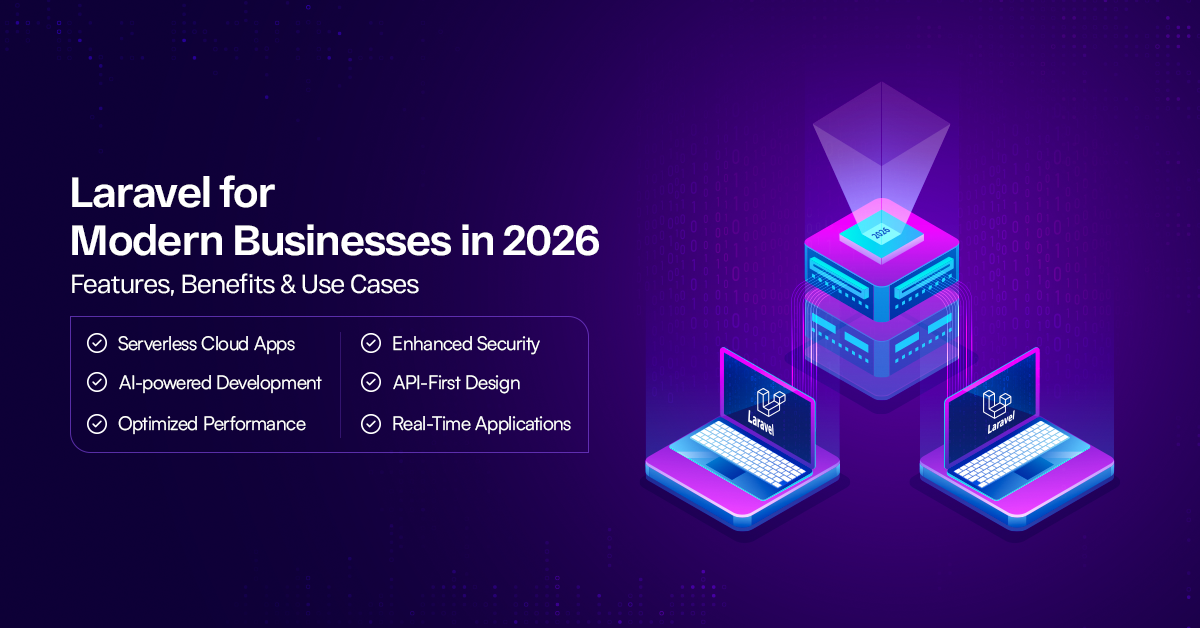
Laravel continues to evolve with modern development trends. Here’s what’s shaping Laravel in 2026:
- Serverless & Cloud-Native Development
Laravel integrates seamlessly with cloud platforms, enabling serverless deployments using tools like Vapor.
- AI-Integrated Development
Developers are now integrating AI features (chatbots, automation, analytics) easily with Laravel-based systems.
- Improved Performance Optimization
Better caching, faster routing, and optimized database queries enhance application speed.
- Enhanced Security Standards
Advanced encryption, token-based authentication, and improved middleware security.
- API-First Architecture
Laravel is increasingly used for headless applications and API-driven ecosystems.
- Real-Time Applications
With broadcasting and WebSockets, Laravel supports real-time apps like dashboards and messaging systems.
Common Use Cases of Laravel
Laravel is widely used across industries for:
- Custom Web Applications
- Enterprise Portals (like HRMS, CMS)
- E-commerce Platforms
- SaaS Applications
- REST APIs & Microservices
- CRM & Vendor Management Systems
Laravel vs Other Frameworks (Quick Insight)
Compared to other PHP frameworks, Laravel stands out because of:
- Better developer experience
- Faster development lifecycle
- Strong community support
- Regular updates and innovation
Is Laravel Worth It in 2026?
Laravel is not just a framework, it’s a complete development ecosystem that empowers businesses to build secure, scalable, and modern applications.
Whether you’re a startup launching your first product or an enterprise upgrading legacy systems, Laravel offers the flexibility, performance, and reliability needed to succeed in 2026 and beyond.